

For many coastal families in Indonesia, climate change does not arrive as a massive or sudden storm. Sometimes it means the rainy season lingers too long and the tides rise just a few centimeters higher.
These changes are quietly disrupting the rhythms of everyday livelihoods.
For salt farmers in Madura, these shifts are a direct threat to survival. Madura remains one of the regions with a high poverty rate, reaching 20%, where communities have historically relied on traditional, solar-dependent salt production. In this area, energy stability is often low, and when the weather turns, the primary source of income for these farmers simply vanishes.
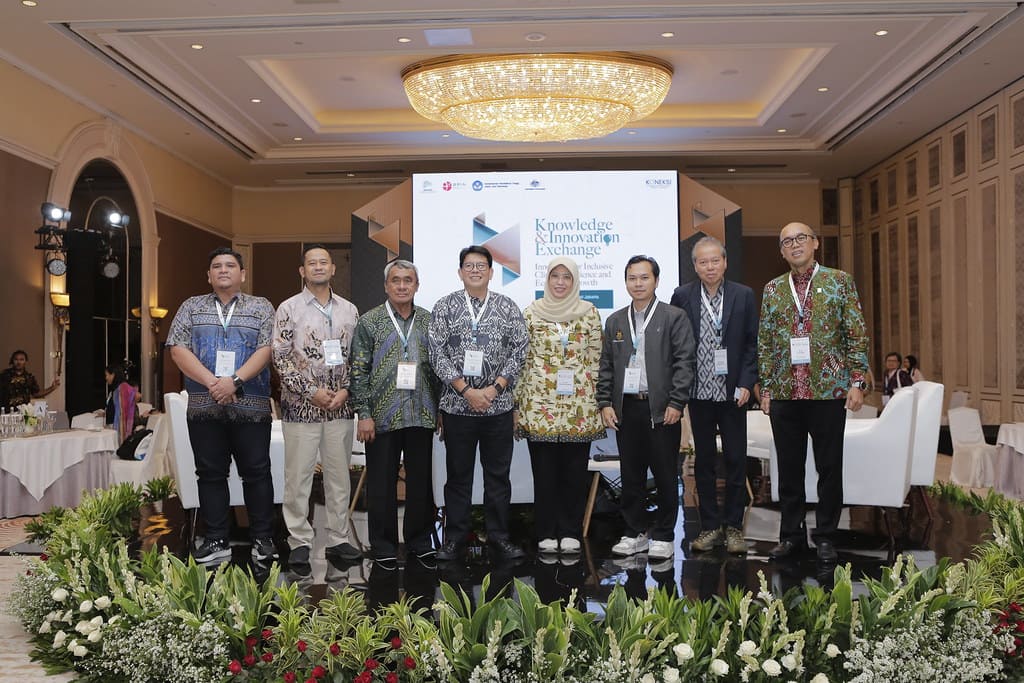
Against this backdrop, on the Knowledge and Innovation Exchange (KIE) Jakarta Summit, held on 28–29 April 2026 at Shangri-La Jakarta, there was also one example of a practical question: what if one village-scale system could help communities produce salt and seaweed, drinking water, and electricity at the same time?
To the uninitiated, this might sound like over-engineering. Why produce everything simultaneously?
Originally, farmers in Madura only relied on salt. To be aware of this, researchers introduced a multi-benefit ecosystem. First, the seawater storage ponds are now used to cultivate seaweed. A strategic move where seaweed naturally absorbs mud and heavy metals, while providing a new income stream from raw products. Simultaneously, the system integrates Organic Rankine Cycle (ORC) and Seawater Reverse Osmosis (SWRO) technologies. So, this allows the farmers to gain:
- Salt (solar-based);
- Cultivated Seaweed;
- Clean Drinking Water (2 liters/minute);
- Stable Electricity (1,764–3,016 W).
Current collaborative efforts emphasize that research should serve as a bridge to address pressing social issues, shifting away from traditional academic metrics to improve livelihoods at the grassroots level.
These diverse solutions were prominently featured at the KIE Jakarta Summit, a vision supported by the Australian Government to tackle real-world crises.
Harvesting Hope from Salt Farmers
KIE Jakarta Summit brought together around 300 participants, including academics, industry representatives, civil society actors, and public sector stakeholders, on the road to Indonesia’s national development priorities (RPJPN) for 2025-2029 and Asta Cita priorities. It showcased 12 research projects across six priority sectors: food, energy, water, health, education, and technology. More broadly, it formed part of a wider Australia–Indonesia Knowledge and Innovation Collaboration Program (KONEKSI) effort that has supported 38 Environment and Climate Change (ECC) research projects, connecting Australian and Indonesian institutions in pursuit of inclusive and sustainable policy and technology.
Far from being a local dialogue, the summit featured world-class insights, while the Madura project is a collaboration between Universitas Trunojoyo in Madura, the University of Newcastle, and RMIT University. Its commitment to inclusivity is proven by integrating GEDSI (Gender Equality, Disability, and Social Inclusion) principles across all research initiatives.
In her opening remarks, Australian Deputy Ambassador to Indonesia Gita Kamath framed this clearly.
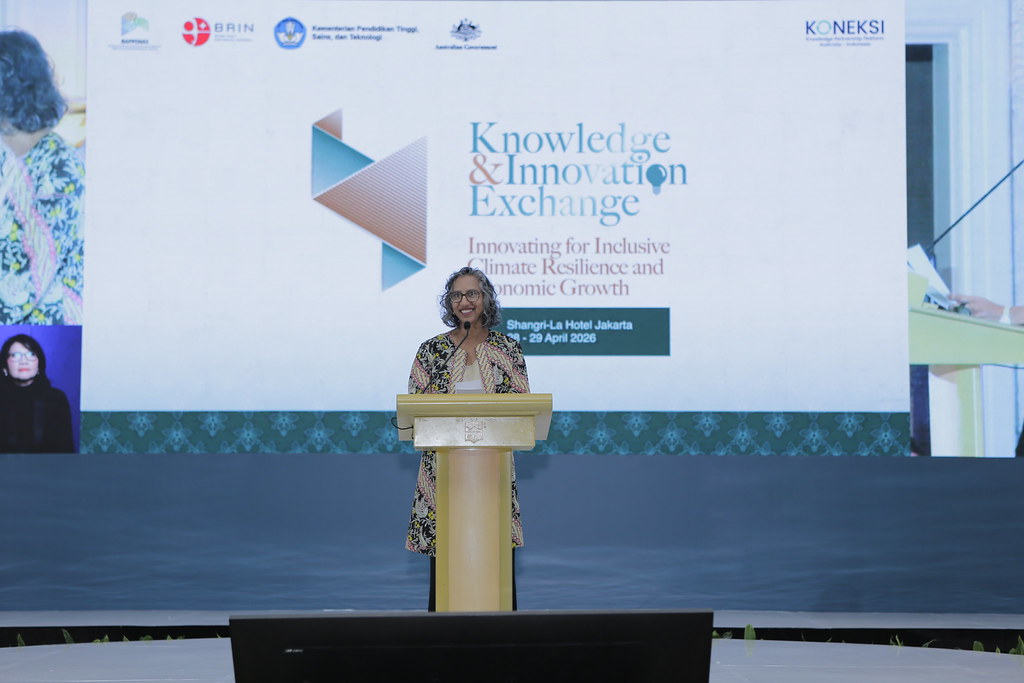
“Education and research partnerships are a strategic investment. They strengthen enduring institutions and, most importantly, deepen the people-to-people links that sit at the heart of the Australia-Indonesia relationship.”
Echoed by Indonesia’s Vice Minister of National Development Planning, Febrian Alphyanto Ruddyard reinforced that KONEKSI is building a comprehensive ecosystem, as a collaborative web linking government, academia, industry, and the media to keep an eye on how climate resilience is not a siloed effort.
Bappenas Deputy for Human Development and Culture, Pungkas Bahjuri Ali, stressed that research that shapes national planning must be “legible, timely, and actionable.” We’ve seen this where the role of communication becomes critical, because a brilliant scientific discovery that remains trapped in an academic journal helps no one on the coastline.
A New Narrative for Development
In that sense, the pathway from research to impact is not only analytical. It is also communicative.
As a public policy communication firm, O2 Consulting understands that grounding climate and research issues for the public is a monumental challenge. Especially, translating research data into an easy-to-digest press release for the journalist requires a specialized bridge.
We recognize that for many organizations, media outreach is the gap link. How do you make high-level research resonate with the newsroom? #TeamO2 has expertise to bridge evidence-based recommendations with strategic communication, media relations, and cross-platform creative production while helping important ideas move into wider public understanding.
At its best, the KIE Jakarta Summit 2026 showed what that journey can look like. Not research for its own sake, but research that responds to real pressures in people’s lives.
This article is part of O2 Consulting’s ongoing interest in strengthening the public value of research through strategic communication and media relations.
Read the news reports:
Antara News. 28 April 2026. Kemdiktisainstek-KONEKSI perkuat riset lingkungan hidup-iklim. Accessed from https://www.antaranews.com/berita/5545416/kemdiktisainstek-koneksi-perkuat-riset-lingkungan-hidup-iklim
CNN Indonesia. 28 April 2026. KONEKSI gelar KIE Jakarta Summit pamer 12 riset RI-Australia. https://www.cnnindonesia.com/teknologi/20260428150625-199-1353051/koneksi-gelar-kie-jakarta-summit-pamer-12-riset-ri-australia
Katadata. 28 April 2026. Bappenas: Riset tak boleh elitis, harus jawab kebutuhan Masyarakat. Accessed from https://katadata.co.id/finansial/makro/69f071b4ee841/bappenas-riset-tak-boleh-elitis-harus-jawab-kebutuhan-masyarakat.
Kompas Lestari. 28 April 2026. Bappenas: Riset lingkungan harus siap pakai saat momentum kebijakan datang. Accessed from https://lestari.kompas.com/read/2026/04/28/193230186/bappenas-riset-lingkungan-harus-siap-pakai-saat-momentum-kebijakan-datang.
Koran Jakarta. 5 May 2026. Pendekatan interdisipliner dinilai krusial percepat prioritas pembangunan nasional. Accessed from https://koran-jakarta.com/2026-05-05/pendekatan-interdisipliner-dinilai-krusial-percepat-prioritas-pembangunan-nasional/amp.
