


Picture this.
It’s 1 a.m. in Jakarta, and you’re doomscrolling. You’ve spent the last hour watching random memes and 15-second clips, but when you stop, you realize you can’t remember a single thing you just saw. Your body is exhausted, but your mind feels fuzzy and restless.
Yes, this feeling is what people are calling brain rot. In a world of high-speed internet and endless short videos, we are filling our heads with junk food content. While it feels entertaining in the moment, it drains our mental energy. Over time, this habit makes it harder for us to focus on important tasks, read a book, or stay productive for more than a few minutes.
What is Brain Rot?
Brain rot isn’t a new concept. People have always found ways to turn their brains off. Today, however, we use it as a relatable term for that heavy digital fatigue we get from spending hours scrolling through low-quality videos.
But looking at it as just a personal bad habit is too simple. If we want to understand how Gen Z and younger audiences consume content, we need to pay closer attention to the media environment behind it.
Screen Burnout at Work
For professionals and office workers today, this constant mental exhaustion is the price we pay for a modern workplace hazard. It is information overload.
As Margaret Storey (2026) posits, cognitive debt is the interest we pay when we prioritize quick, fragmented interactions over structural understanding. Every quick scroll leaves attention residue, with parts of our focus stuck on the previous stimulus.
A kind of debt manifests as a decline in deep-work capacity. According to Schiavo & Andrao (2026), the rise of AI-generated content often fuels brain-rot aesthetics, adding another layer of psychological cost, as users must constantly switch between irony, absurdity, and reality. Expert analysis identifies three primary drivers of brain rot:
-
- Digital literacy and parenting styles,
-
- Public consumption patterns and psychological states, and
- The influence of algorithms coupled with content overload.
About 91% of Entertainment Shapes Youth Culture
For many young users, brain-rot content can function to participate in shared online culture. Absurd memes, chaotic humor, and low-context references often drive people to connect quickly with peers who recognize the same patterns, language, and tone.
Part of the appeal can be explained by the incongruity: people find things funny when they break expectations. On the surface, it may seem empty. In practice, it often creates a sense of belonging. This is one reason brands and institutions sometimes misread youth cultures
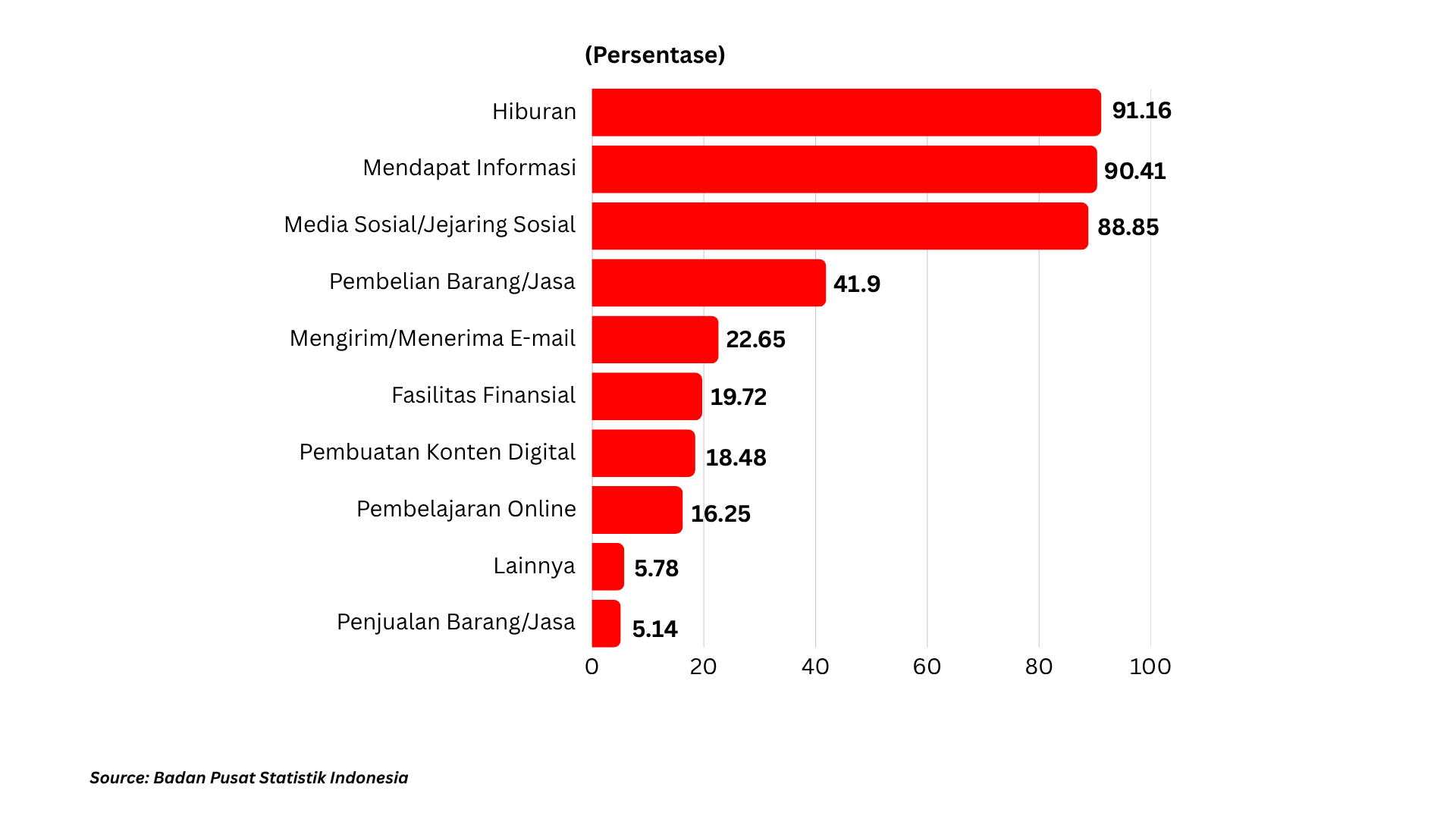
Purposes of Indonesian Youth Using the Internet
In 2025, the primary driver for internet usage among Indonesian youth (16-30 years old) is Entertainment (91.16%), slightly outpacing Information Seeking (90.41%) and Social Media (88.85%). In this context, the content that spreads fastest is often the content that is easiest to react to and remix without reflection. When entertainment becomes the dominant lens through which the digital world is experienced, the threshold for meaningful content shifts toward the immediate, the ironic, and the absurd.
Digital Overload
We may see the phenomenon of brain-rot as a direct consequence of a saturated digital landscape. When we analyze the actual impact, the data reveal a generational divide in cognitive and physical well-being.
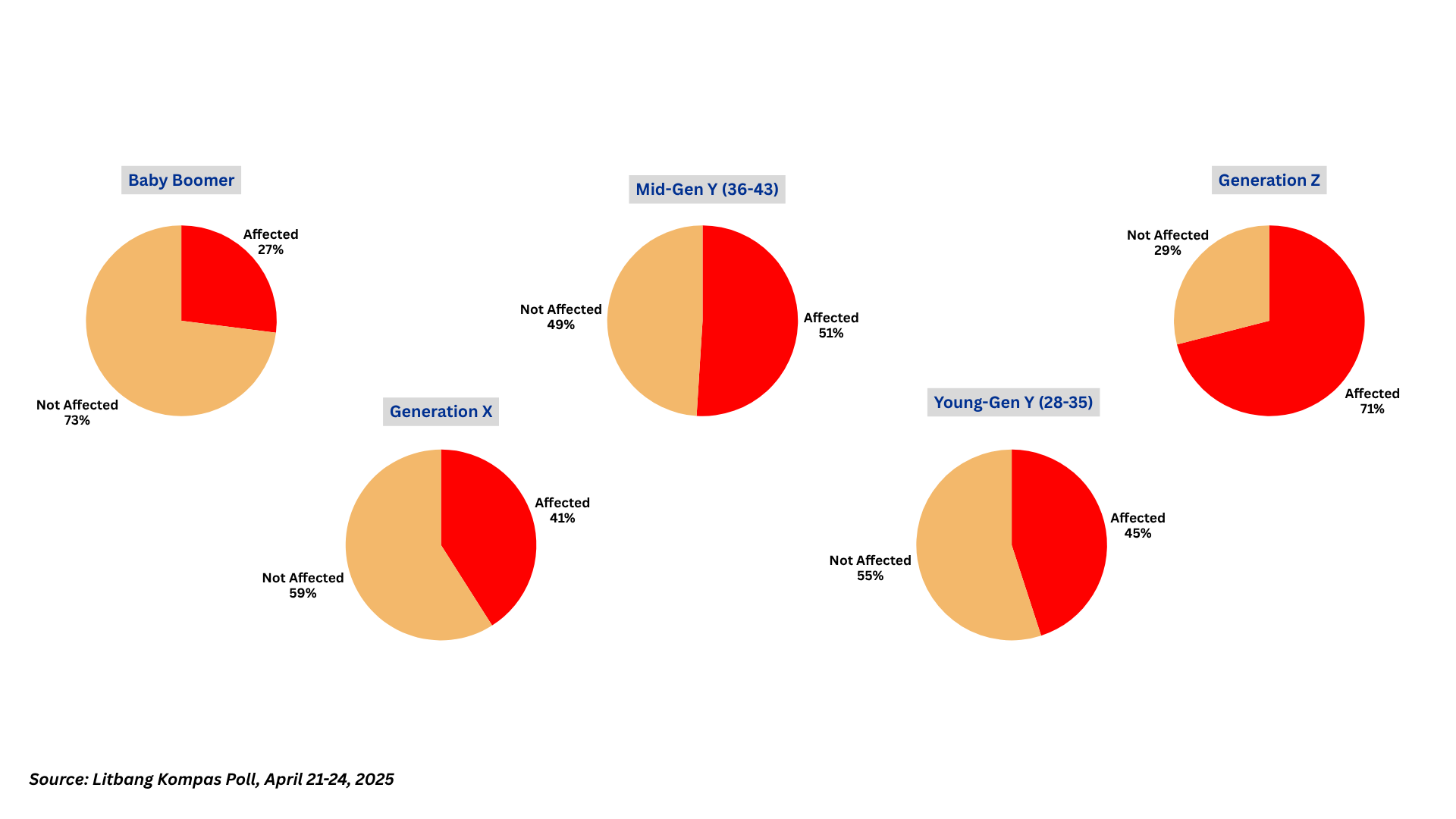
Screen-Related Disorders by Generation
According to the Litbang Kompas data 2025, a staggering 71.09% of Gen Z respondents report experiencing disruptions ranging from physical fatigue and psychological strain to a withdrawal from social interaction because of excessive screen time.
When users are conditioned to react instantly, the line between a meme, a joke, and a misleading claim becomes blurred. For organizations, this means your message is no longer just competing with rivals.
Gen Z Workers Culture
Gen Z workers have grown up in a bullet-point culture, from Instagram captions to 15-second TikTok hooks. While efficient for speed, this environment erodes the ability to construct a linear narrative for brainstorming.
In the workplace, PowerPoint is often a trap for Gen Z workers because it allows them to hide a lack of deep logic behind high-quality visuals and vibes. By banning slides through Amazon’s six-page narrative, Gen Z workers are forced to move into structured, narrative arguments that directly pay down their cognitive debt. To achieve this, you can employ a clarity story pattern (Callahan, 2018) within your memos:
-
- In the past, it was like this …
-
- Then something happened …
-
- So, now we should do this …
-
- So, the future might be like this …
This specific framework is widely used by global giants in the management consulting, energy, and financial services sectors, serving as a deceptively simple yet powerful tool for broad information.
For communicators, if audiences are overwhelmed, faster messaging is not always better messaging. As a public policy communication firm, O2 Consulting is committed to serving as a strategic partner in providing data-driven recommendations and developing comprehensive communication strategies. Our expertise includes media relations management, campaign design, and the production of creative materials across diverse digital platforms.
Brain rot may sound like a joke, but it signals a serious shift in how younger audiences experience digital life.
REFERENCES
Götzfried, A., & Heitmayer, M. (2026). BrAInrot–Making Sense of Nonsense A qualitative study on how low-quality content serves Generation Z’s media needs computers in Human Behavior: Artificial Humans, 100255.
Robertson, C., Ross Arguedas, A., Mukherjee, M., & Fletcher, R. (2026). Understanding young news audiences at a time of rapid change.
Schiavo, G., & Andrao, M. (2026, April). Talking About Brainrot: Youth Engagement with AI-Generated Content and the Dynamics of Intergenerational Communication. In Proceedings of the 2026 CHI Conference on Human Factors in Computing Systems (pp. 1-13).
Chan, Alan. (2026). The Amazon 6-Pager: What, Why, and How. Accessed from https://www.larksuite.com/en_us/blog/amazon-6-pager
Gallagher, Meg. (2025). The growing use of brain rot has become a new way of communication for Gen-Z. Accessed from https://hhsjournalism.com/hilltopper-news/current-events/2025/03/25/brain-rots-growing-use-has-become-a-new-way-of-communication-for-gen-z/
Summit. (2024). What is “Brain Rot,” and What Does it Suggest about Social Media Habits? The Summit Wellness Group. Accessed from https://thesummitwellnessgroup.com/blog/what-is-brain-rot/
The Effective Project Manager. (2024). The Ultimate Guide to Amazon’s 6-Pager Memo Method. Accessed from https://medium.com/@info_14390/the-ultimate-guide-to-amazons-6-pager-memo-method-c4b683441593
Wisanggeni, Satrio Pangarso. Widyastuti, Ratna Sri. Sri Rejeki. (2025). “Brain Rot” Lurks in the Young Generation. Kompas. Accessed from https://www.kompas.id/artikel/en-brain-rot-mengintai-generasi-muda-2.
